There is a firm that has made every move the series described.
It crossed the Trust Ceiling. It built growth leverage. It passed the Indispensability Test — the customer has acknowledged, in conversations if not always in contracts, that the outcomes being created would not exist without this firm. Participation followed. There is a revenue-sharing arrangement in place. The firm benefits when growth arrives.
And then growth stalls.
The strategy needs to change. Decisions need to be made — about direction, about investment, about what to stop and what to accelerate. These are the decisions that will determine whether the arrangement ever pays out.
The firm watches those decisions being made from the outside.
Not because it is distrusted. Not because it lacks influence. But because when the moment arrived — the moment of real consequence, real risk, real accountability — the customer made the calls alone. The firm was consulted. Its perspective was valued. The keys stayed where they always were.
This is not a failure of relationship. It is a signal about something the relationship alone cannot resolve. Participation and ownership are not the same position. And the firm, despite everything it has built, has not yet crossed the distance between them.
The Distance Between Participation And Ownership
B2 established that participation is an economic right. A firm that has demonstrated indispensability — cross-enterprise reach, capital at risk, leverage the customer cannot replicate internally — earns a share of the value it helps create. Revenue share. Co-investment. Outcome-based structures. These are genuine achievements.
But participation is about economics. Ownership is about something different.
The distinction appears most clearly at the moment of failure. When the outcome disappoints — when the market does not expand as planned, when the strategy produces less than expected, when the growth the arrangement was built around does not arrive — two questions surface immediately. They are not the same question, and who answers each one reveals exactly where the relationship stands.
The first question is economic: who absorbs the financial consequence?
The second question is structural: who is expected to explain what happened, correct the course, and carry the outcome forward?
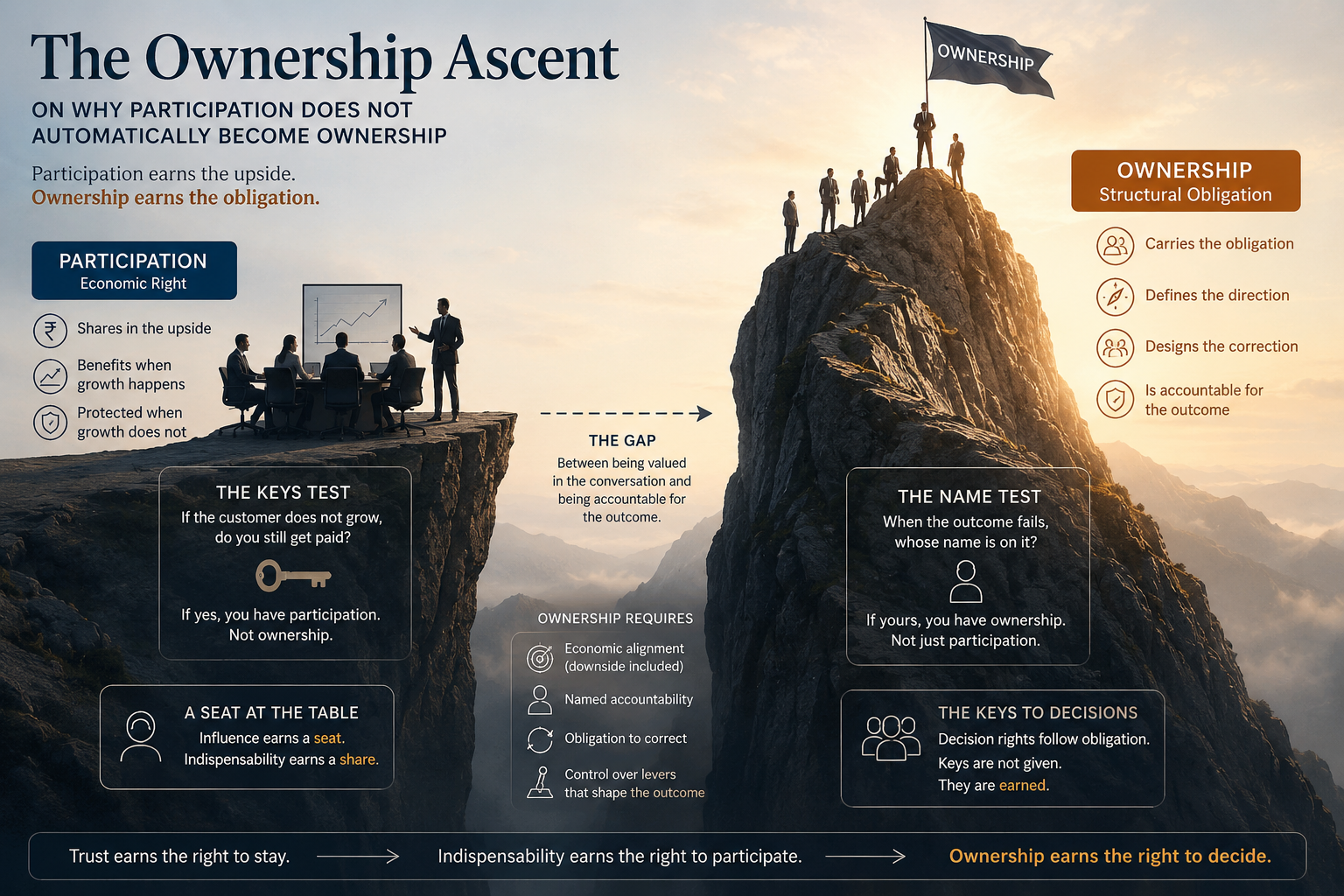
Participation answers the first question. A firm in a well-designed revenue-sharing arrangement absorbs a portion of the financial consequence when growth disappoints — its revenue declines with the customer’s results. That is real. That is meaningful. That is not, by itself, ownership.
Ownership answers the second question. The firm whose name is on the outcome — the firm the customer expects to hear from first when results disappoint, whose people are expected in the room where the correction is designed, who carries the obligation to fix what the strategy got wrong — that firm has ownership. It is not merely a beneficiary or a victim of the result. It is responsible for it.
Participation earns the upside. Ownership earns the obligation.
The Keys Test
There is a commercial diagnostic that makes the distinction visible.
If the customer does not grow, do you still get paid?
A firm that earns fees whether or not the customer grows has participation in name but not in structure. Its commercial model tells the customer, every day, that the firm benefits when things work and is protected from consequence when they do not. The customer reads this signal clearly: this firm shares our ambition. It does not share our risk. And so — rationally, without malice — the customer keeps the keys to the decisions that determine the outcome.
A firm whose revenue disappears when the customer’s growth does not arrive has changed the signal. Its economics and the customer’s outcomes are now the same variable. This is a necessary step toward ownership. But it is not sufficient.
Because control does not flow to the firm that has merely put money at risk. It flows to the firm that has accepted the obligation — the named accountability, the expectation of explanation, the responsibility for correction. Downside economics is the commercial proof of that acceptance. It is not the acceptance itself.
The Keys Test asks the right commercial question. The deeper diagnostic goes one level further.
The Name Test
When the outcome fails — not the project, the outcome — whose name is on it?
In every technology services engagement, there is a moment when results disappoint and someone must stand in front of the customer’s leadership and explain what happened. Not what the data shows. What went wrong, what needs to change, and who is accountable for the course correction.
If that person is always on the customer’s side of the table, the firm has participation. It may be trusted, influential, indispensable, and commercially aligned. But it is a participant in a result owned by someone else.
If that person is in the firm — if the firm’s leadership is expected in the room, owns the explanation, carries the design of the correction, and is genuinely accountable for what happens next — ownership has begun. Not as a grant of authority, but as an acceptance of obligation. The customer has extended the right to be wrong in a way that requires the firm to fix it. That is the deepest form of what keys actually unlock.
This is why decision rights flow from obligation, not from relationship.
A customer does not give keys to the firm it likes most. It gives keys to the firm it holds responsible.
The two are not the same. And confusing them is why firms that have genuine influence and genuine participation still find themselves watching the consequential decisions from outside the room.
Participation makes you a beneficiary of the outcome. Ownership makes you responsible for it.
Many firms carry obligation informally, without naming it. They step into accountability gaps, own corrections, stand in the room when results disappoint. Ownership begins when that obligation becomes explicit — when the customer not only senses it but names it, structures around it, and extends the decision rights that logically follow.
Decision rights follow obligation.
That is the bridge from this episode to the next. A firm that has accepted the obligation — commercially, behaviourally, and structurally — will find that the question of decision rights resolves itself. The customer does not grant authority to the firm it trusts most. It grants authority to the firm it holds most responsible. And that responsibility, once accepted and demonstrated, makes the withholding of decision rights irrational.
Why The Customer Withholds The Keys
Most technology services leaders, when they analyse why ownership has not arrived, look for a relationship explanation. We need more trust. We need more access. We need a stronger executive sponsor.
The explanation is rarely relational. It is structural.
A customer who withholds decision rights from a trusted, influential, indispensable firm is not making a relationship judgement. They are making a structural one: I do not yet see evidence that this firm will carry the obligation when the outcome fails.
That evidence has two forms.
The first is commercial. A firm whose economics are genuinely at risk against the outcome — not protected by base fees, not insulated by minimums — has demonstrated a willingness to carry consequence financially. The Keys Test surfaces this.
The second is behavioural. A firm that has, in prior moments, stepped into the accountability gap — that has owned an explanation the customer did not want to give, that has carried the correction of a strategy it did not design alone, that has stood in the room when results disappointed and said “this is ours to fix” — has demonstrated something the commercial structure alone cannot prove. That it will carry the obligation when it counts.
The customer is watching for both. Most firms provide neither. They protect their fees and they redirect accountability to factors outside their control — market conditions, customer decisions, external forces. Both responses confirm the same thing to the customer: this firm is not ready to carry what ownership requires.
The GCC Cannot Carry The Obligation
The GCC structural law — a GCC is designed to optimise one enterprise, the Expansion Zone is built on leverage across enterprises — has a specific implication at the ownership layer.
A GCC has no independent obligation to carry.
When an initiative fails, the GCC’s accountability runs upward — to its parent organisation’s leadership, through internal governance structures, into the enterprise’s own decision-making. The consequence is absorbed internally. The GCC is not expected to stand in front of external stakeholders and carry the explanation. It is an extension of the enterprise, and extensions do not carry obligation independent of the entity they extend.
A technology services firm that has genuinely accepted external accountability — whose name is on the outcome, whose leadership is in the room when results disappoint, whose obligation to correct and carry runs toward the customer rather than toward its own internal governance — has something a GCC structurally cannot offer. Not because the GCC lacks capability. Because the GCC is designed to internalise consequence, not to carry it externally.
This is why the GCC, at the ownership layer as at every other, stops being a competitor and becomes evidence. A customer who has a mature GCC and still seeks an external firm to carry ownership is telling you something precise: they understand the difference between internal accountability and external obligation. They are not looking for the GCC to become the firm. They are looking for the firm to carry what the GCC, by its nature, cannot.
The Ownership Ascent
The ascent from participation to ownership is not made in a conversation about decision rights. It is made in a series of demonstrated acceptances of obligation — commercial, behavioural, and structural — that change what the firm is in the relationship.
It begins with the commercial signal. Restructuring the engagement so that the firm’s economics are genuinely at risk against the outcome removes the insulation that tells the customer the firm is a beneficiary rather than a co-owner. This is uncomfortable. Most firms resist it. The discomfort is not a reason to stop. The discomfort is the signal that something real is changing.
It continues with the behavioural record. The moments when the firm stepped into the accountability gap — owned an explanation, carried a correction, stood in the room when results disappointed — build the evidence the customer is watching for. These moments cannot be manufactured. They arise when results disappoint, which is precisely when most firms retreat to the protection of their commercial arrangements and point outward. The firms that step in instead are the ones the customer eventually trusts with the keys.
And it culminates in a structural shift that most technology services relationships never reach: the firm is not merely present in the governance of the outcome. It is named in it. Its people are accountable parties, not participants. Its decisions are the decisions. Its obligation is explicit, not implied.
Ownership does not arrive because the customer decided to be generous. It arrives because the customer looked at the commercial structure, the behavioural record, and the structural reality, and concluded that withholding the keys no longer made sense. The obligation was already there. The keys were the logical consequence.
Run This In Your Organisation
Five questions for leadership teams asking why participation has not become ownership.
Question 1 — The Keys Test
In your most significant revenue-sharing engagement — if the customer does not grow over the next twelve months, what happens to your firm’s revenue?
Does it decline in proportion to the growth shortfall? Or are you protected by a base fee, a retainer, or a minimum that insulates your income from the outcome?
Write the honest answer. If your revenue is protected from the customer’s underperformance, you have participation. The keys are staying where they are.
Question 2 — The Name Test
In that same engagement — when the outcome last disappointed, whose name was on the explanation?
Who was in the room? Who owned the correction? Who carried the accountability for what happened next — in a way that could not be redirected to market conditions, customer decisions, or factors outside the firm’s control?
If the name was always on the customer’s side of the table, you have participation without ownership. The firm has not yet accepted the obligation that earns the keys.
Question 3 — The accountability gap
Name a specific moment in the last twelve months when your firm stepped into the accountability gap — when results disappointed and your firm owned the explanation, the correction, and the consequence rather than redirecting to external factors.
If you cannot name one, the customer has not yet seen the behavioural evidence that ownership requires. They are not withholding the keys because they distrust you. They are withholding them because the evidence is not yet there.
Question 4 — The GCC comparison
Does your customer have a GCC or a growing internal capability?
When your customer’s initiative underperforms, does the GCC carry the external obligation — standing in front of the customer’s leadership, owning the explanation, designing the correction — or does that accountability run inward through the parent organisation’s governance?
Name specifically what external obligation you carry that the GCC structurally cannot. That is the gap between what the GCC offers and what ownership requires.
Question 5 — The first structural move
Of the three elements of the Ownership Ascent — commercial signal, behavioural record, structural accountability — which one is most clearly missing in your most important engagement?
What would it take to close that gap specifically — not in general terms, but in this relationship, with this customer, in the next ninety days?
Who owns making that move? By when?
Ownership is not a relationship milestone. It is an accepted obligation. The firm whose name is on the outcome — whose economics disappear when growth does not arrive, whose people carry the explanation when strategy fails, whose accountability runs toward the customer rather than toward its own governance — is the firm the customer eventually trusts with the keys. Not as a reward. As a logical consequence.