There is an organisation that most senior leaders in technology services will recognise immediately.
It executes well. It has built deep domain knowledge over years. Its teams are capable and committed. It has earned, through consistent delivery across difficult conditions, something genuinely rare — the customer’s trust. The relationship is strong. The partner is valued. By every visible measure, the organisation has earned the right to more.
Yet more never quite arrives.
The work expands. The responsibility expands. The accountability expands. But the strategic conversations remain on the customer’s side of the table. The growth discussions conclude with a polite acknowledgement of how far the relationship has come. The strategic influence that seems to logically follow years of trusted execution does not follow. The organisation is deeply embedded with the customer and simultaneously unable to explain why it is not growing.
The instinct is to execute harder. To prove more. To demonstrate that the capability is there, the commitment is there, the readiness is there.
This instinct is not wrong. It is simply aimed at the wrong ceiling.
The mistake many firms make is believing that trust naturally compounds into influence. It does not. Trust earns the right to stay in the room. Growth leverage earns the right to shape the conversation. These are not the same right, and confusing them is where most mature relationships stall.
What The Trust Ceiling Is
Every technology services relationship has two distinct phases. Most firms do not notice when they cross from one to the other.
In the first phase, the ceiling is capability. The customer is asking whether the work can be done, whether commitments will be honoured, whether the team can be depended upon. These questions are answered through execution — through delivery, through consistency, through showing up under pressure and meeting the commitments that were made. This is familiar ground. Most mature service organisations have long since learned to work here.
But there is a second ceiling, and it is not a capability ceiling at all.
Call it the Trust Ceiling.
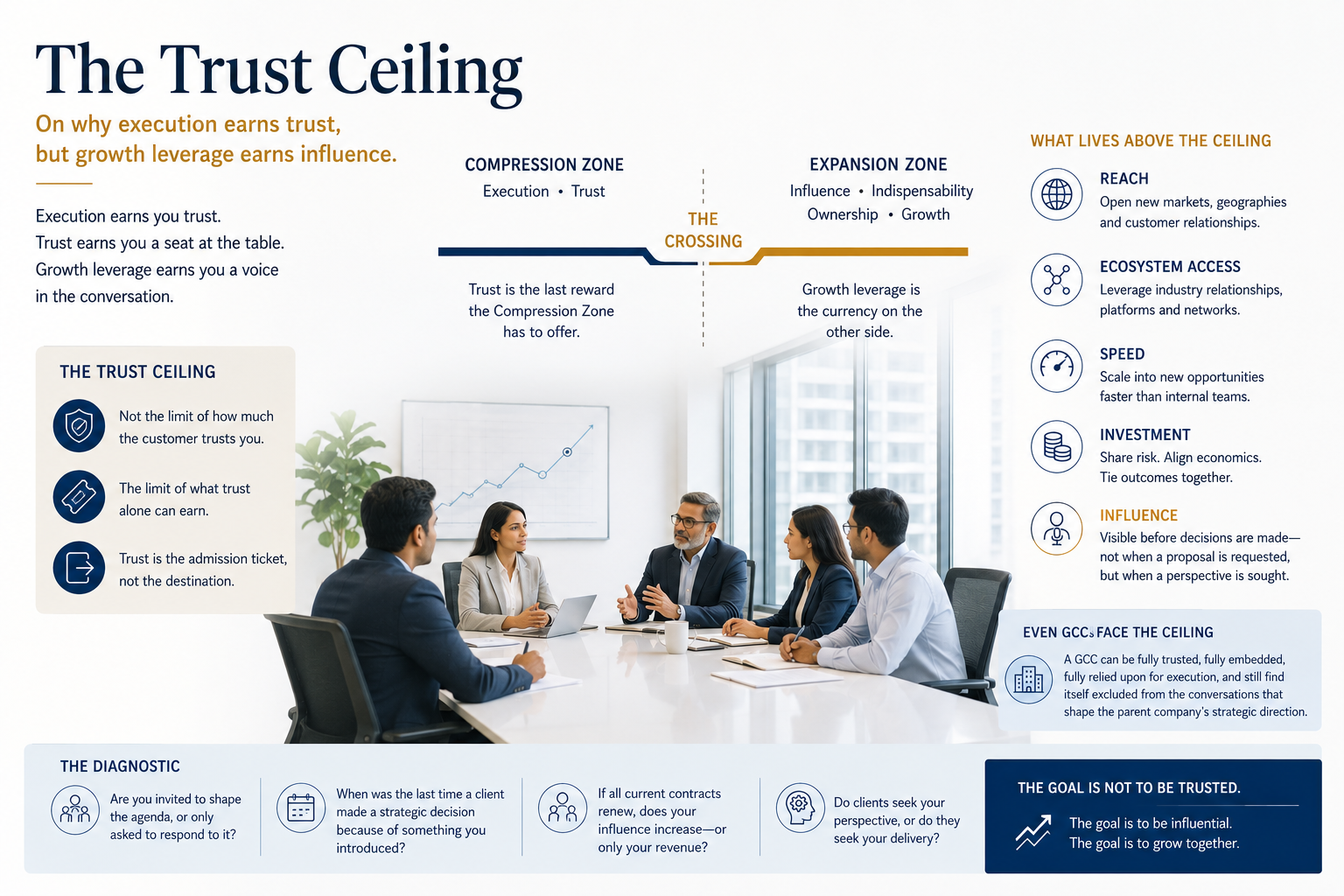
The Trust Ceiling is not the limit of how much the customer trusts you. It is the limit of what trust alone can earn. A customer can trust a partner completely — believe, without reservation, in the partner’s competence and integrity — and still not expand the relationship beyond execution. Not because trust is absent. Because trust is the admission ticket to the relationship, not the destination within it.
This is the misread at the heart of most growth stagnation in mature service relationships. The firm that believes it simply needs to earn more trust, deliver more consistently, prove more capability — is solving for a gate it passed years ago.
The Compression Zone rewards execution. The Expansion Zone rewards leverage. Trust is the last reward the Compression Zone has to offer — and the first asset most firms reach for when trying to enter the Expansion Zone. It does not work, because trust was never the currency on the other side.
A Relationship That Taught This
Several years ago, I watched this play out in a large technology product relationship.
The team had done everything right. Knowledge transfer was completed, domain expertise deepened, features shipped consistently, customer issues resolved, service levels maintained. By every visible delivery measure, the organisation was ready for greater ownership.
Ownership never transferred.
The first explanation seemed obvious: the team needed to prove more. Looking back, that explanation is incomplete. The customer had already accepted capability. The customer had already accepted trust. What remained unresolved were entirely different questions — questions about economic alignment, about whether the partner could help the customer grow and not merely help the customer run, about what the relationship might create that neither party could create alone.
The team was answering the capability question long after the customer had moved to asking the growth question.
The relationship had reached the Trust Ceiling — not because trust was insufficient, but because trust alone was no longer the bottleneck. And the firm, not seeing the ceiling for what it was, kept pressing on the lever it had always used. The lever that no longer connected to what the customer was withholding.
What Lives Above The Ceiling
If trust is the admission ticket, what is the destination?
It is not ownership, though ownership is one possible outcome. The destination is what I would call growth leverage — the capacity of a partner to help a customer create value faster than the customer could create alone. Execution helps a customer run the business they already have. Growth leverage helps the customer grow into the business they are trying to build. Both matter. But they answer different questions, and confusing them is the root of most Trust Ceiling situations.
Growth leverage takes several forms, and not every partner can credibly offer every form.
Reach — the ability to open new markets, new geographies, new customer relationships the customer could not access without the partner. Ecosystem access — industry relationships, platform connections, and network effects that accelerate what the customer is building. Speed — the capacity to scale into new positions and capture opportunities faster than internal resources alone would permit. And investment — the willingness to co-invest, to share risk, to tie the partner’s economics genuinely to the customer’s outcomes rather than to the partner’s effort.
Influence is what these forms of leverage produce, and it has a specific signature. Influence is visible before decisions are made — not when the customer asks for a proposal, but when the customer asks for a perspective. The partner with influence is in the room while the strategy is still being shaped, not summoned afterward to execute it. That is the destination above the Trust Ceiling: not more work, not more responsibility, but a seat in the conversation before the conversation becomes a brief.
Customers rarely share influence as a reward for past execution. They share influence when they believe a partner can change the future trajectory of the business.
Growth leverage matters because it alters possibilities — opening markets, accelerating adoption, expanding reach, reducing the time required to capture an opportunity. Execution protects value. Growth leverage creates value. The distinction is subtle, but it explains why some trusted relationships plateau while others evolve.
What these forms share is a shift in the fundamental question the partner answers. Not can you run this but can we grow this together. That shift changes the nature of the relationship entirely. And it cannot be made through execution alone, however excellent.
What GenAI Accelerates
GenAI does not create the Trust Ceiling. It existed in every mature service relationship long before GenAI arrived. What GenAI changes is the speed at which firms encounter it.
For decades, execution at scale was the scarcity that mattered — difficult to build, difficult to replicate, and the foundation on which entire business models and careers were constructed. GenAI compresses that value. Capabilities that required years to build become easier to reproduce. As execution becomes less scarce, the questions customers ask shift upward — from capability and trust toward growth leverage and economic alignment. The Trust Ceiling was always there. GenAI is lowering the floor beneath it, which makes the ceiling feel suddenly much closer.
The firms that respond by executing harder are building on ground that is, quietly, losing altitude. The firms that ask what growth leverage they can credibly create for the customer are building on the ground that remains.
The Trust Ceiling is not unique to external partners. It is just as real for Global Capability Centres — internal teams that have earned the deepest possible trust of their parent organisation. A GCC can be fully trusted, fully embedded, fully relied upon for execution, and still find itself excluded from the conversations that shape the parent company’s strategic direction. Internal trust hits the same ceiling external trust does, for the same reason: trust answers the question of whether the work will get done. It does not answer the question of whether this team can help the organisation become something it is not yet.
The Transition That Is Available
The transition from execution to growth leverage is not a rebranding exercise. It requires an honest examination of what the partner actually offers above the Trust Ceiling — and a willingness to restructure the relationship around it.
It begins with a different question. Not how do we demonstrate more capability but how does this customer need to grow, and where could we accelerate that? This question is rarely asked inside delivery relationships, because delivery relationships are designed around what the customer already needs. Asking it is deliberate, and it changes the conversation.
It continues with a willingness to tie economics to outcomes. Execution is paid for with fees. Growth leverage is recognised through shared upside — revenue share, co-investment, go-to-market partnerships, joint ventures. These structures are uncomfortable for organisations whose operating models are built around effort-based compensation. But they are the only commercial signal that communicates alignment in a way the customer can actually feel. A proposal can claim growth leverage. A commercial structure proves it.
And it depends on honesty about what growth leverage is genuinely available. Not every firm can create reach for every customer. Not every partnership opens new markets. The transition is real only where the partner has something genuinely scarce to offer above the ceiling. Claiming leverage without having it does not move the relationship — because the customer, even if they cannot name what they are sensing, will sense the gap between what is proposed and what the operating model can deliver.
Execution earns trust. Trust earns access. Growth leverage earns influence. And influence is what ultimately changes the shape of the relationship.
Run This In Your Organisation
Five questions for leadership teams asking why trust is not translating into growth.
Question 1 — The ceiling check
Name your three most trusted customer relationships.
For each one: has the relationship grown strategically in the last two years — in influence, in ownership, in the kind of conversations you are included in — or has it grown only operationally: more work, more responsibility, more headcount, without a change in strategic standing?
If operational growth is consistent and strategic growth is absent — you have identified the Trust Ceiling in that relationship. Name the relationship specifically.
Question 2 — The question the customer is asking
In your most important customer relationship — what question is the customer currently asking you?
A capability question: can you do this, will you do this reliably?
Or a growth question: can you help us build something we cannot build as fast alone?
If you are not certain, ask the account leader to answer honestly. The question that is active determines the ceiling that is active.
Question 3 — The growth leverage audit
Of the four forms of growth leverage — reach, ecosystem access, speed, investment — name the one your organisation could create most credibly for your most important customer.
Not aspirationally. Credibly — based on what you actually have that the customer does not.
If you cannot name one with specificity, the Trust Ceiling will hold. The transition requires something real above it, not a better description of what is already there.
Question 4 — The economic signal
Where in your current significant relationships have you tied your economics to the customer’s outcomes rather than your effort?
Revenue share. Co-investment. Risk sharing. Outcome-based structures with real consequences on your side.
Name them specifically. If you cannot name them — your commercial model is still signalling execution. And execution, credibly signalled, keeps the ceiling exactly where it is.
Question 5 — The first move
Name one relationship where the transition from execution to growth leverage is worth attempting.
Name the specific form of leverage you could credibly offer.
Name the conversation that needs to happen — and the person in your organisation best placed to initiate it.
Who owns it? By when?
The Trust Ceiling is not a failure of execution. It is a signal that execution has done its job. The question is what comes next — and whether the organisation is deliberately building it, or continuing to prove what it has already proved.